We have used the ‘perfect storm’ analogy to give context to the critical importance of organisations having current insights to create suitable strategies for the future. As we start to see the first tentative steps out of lockdown in the UK it may feel as if we are reaching a period of calm. For some organisations, though, this might literally be the eye of the storm that continues to rage around us. The future for many remains uncertain and ensuring that we have insight into critical elements now is more important than ever to be able to successfully navigate through it.
In the first three articles we looked at what to consider in gaining current insight into our employees,customersand the markets that we operate within.
Understanding your organisation
Having understood the needs arising from research of these three elements we need to consider how well our organisation is aligned with them.
Our own research, conducted at the end of 2020, revealed that some of the key impacts of the uncertainty wrought by COVID and Brexit on organisations were seen as being:
Supply issues (especially initially)
Workplace structures
Employees – e.g. working from home, motivation, management, support, anxiety and retention
Culture – maintaining positive aspects of organisational culture in the absence of face to face contact
Service quality pressures
Cost cutting
Leadership style challenges
Pivoting strategies’ suitability
When we think about strategy we will often think about suitability and fit. For example:
“Does the proposed strategy fit the culture, leadership style and structure of the organisation?”
During the ‘eye of a storm’ it is well worth looking at this from another viewpoint. From a research perspective the question could be posed the other way around:
“Does the organisationfit the required strategy?”
The ‘six’ elements
What should we consider against this thinking?
There are numerous aspects of the organisation that might need to be researched.
Here are six key aspects for us to explore:
Structure
An organisation chart can reveal so much about the way that an organisation works and its culture. Looking at your own structure, consider the following:
Is it up to date? Organisation charts are often in need of revision.
Does it accurately reflect the interactions that take place? For example, charts are typically in straight lines – would a 3D view be more appropriate?
How relevant is it to the current situation and the needs that have arisen from your previous insights (employees, customers and markets)
Does it suit a shift to working from home?
Is there still a requirement for the same premises, for example?
How does the structure impact on processes?
Is the structure relevant to the market or markets that you are in or need to be in?
Leadership
How does your organisation’s leadership align with the insights gained so far?
What is or are the predominant style(s) of your leaders?
What are the gaps in leadership capabilities? For example:
Digital know-how
Innovation
Change
Communicating future direction
People selection and development
Culture
“The way we do things around here”
What is the organisational culture? Can you define it? How would others define it?
Culture has a massive impact on the way that an organisation works.
A cultural audit is invaluable to consider where there may be issues with strategic fit. Is there any inertia evident as a result of the significant uncertainties over the past 12 months, for example?
One excellent way of doing this is to use the Cultural Web – a tool created by Johnson and Scholes.
What are the values of the organisation? How do these resonate or otherwise with your employees, customers and markets?
Values are increasingly important and can have a key impact on how your brand is perceived too.
For example, think about your stance on societal issues such as diversity and equity.
Processes
You may have already considered where key processes are impacting on customer experience but what about some of the less obvious ones. There are so often things that we do that are no longer questioned.
Challenge the processes in place across the whole organisation. Which are aligned to what you have discovered so far and which are creating barriers to your future success?
Consider digital transformation, for example. To what extent has the organisation adopted digital technologies into its processes?
What about barriers to positive behaviour?
Crawford Hollingsworth wrote an article in impact magazine about auditing ‘sludge’. It is not a term that I had heard before but seems quite apt to undertaking research on the organisation now. Sludge is..
“…when consumers or businesses face high levels of friction that obstruct their efforts to achieve something that is in their best interest, or are deliberately misled or encouraged to take action that is not in their best interest.”
Crawford Hollingsworth
This is all about making behaviour easier for organisations and customers alike. You can find out more about ‘sludge’ here.
Internal communications
Explore how your organisation communicates internally. There is no intent to state the obvious in terms of how important this is or to suggest that it isn’t already top of mind. Like all the above elements, the focus has shifted significantly over the past year so demands review.
Consider some of the following;
How have your internal communications approaches changed to recognise the shift in working patterns? Are the approaches appropriate?
Who is responsible for the overall management of internal communications? Is this in the right place?
Are you communicating a clear roadmap to employees for how and when the organisation plans to navigate out of the storm?
How are you getting feedback on your communications? Do you need to consider new channels?
THE BOTTOM LINE
“Fundamentally…
… is your organisation as aligned to the expectations of your employees, customers and markets as it needs to be?
What do you need to change to make your organisation the right fit for the strategies that will take it successfully out of the storm?”
If you would like someone to talk to about any of this, give me a call.
Why you need to research your markets now – the market view
In the last two articles we have highlighted the major shocks that organisations and individuals are continuing to face from the lack of certainty and volatility in the world that we live in now. The transition period following Brexit has ended but COVID continues to have a significant impact on us all.
Many organisations continue to face major challenges due to this.
In our work and personal lives we all need something that we can anchor our plans around.
From a business perspective, we need to understand as best we can what is going on in the marketplaces that we interact with. This has always been the case but in the current climate it is more important than ever that we have this insight to enable us to create a roadmap for the future.
Understanding your markets
After researching the foundations of your organisation – its people and its customers – the next area to explore is your markets.
“Before we do anything from a strategy perspective, it is vital to know where we are now.”
So what are the key things we need to know?
What is the impact on the market(s) that you are in from the major shocks over the past year?
How have they changed?
Have they grown?
Different dynamics. A shift in the way in which the market(s) work.
Declined?
Stayed the same?
Frozen?
Disappeared?
What are the main factors that have caused the changes and why?
How has your organisation performed against these changes?
Research will usually reveal things that we didn’t know. It is more than possible, therefore, that we may not have been aware of some of the market changes that have happened. Where you have identified changes:
What have you done to address them?
What has worked?
What hasn’t?
What measures have you used? For example:
Market share
Turnover
Profit or loss
ROI
Customer value
Customer retention
Likelihood to recommend
Which are new for the past year?
What about your competitors?
How are your competitors doing? What are they doing?
Think about the wider competitive environment too. What is changing? How are these changes affecting your organisation?
We looked at changing customer behaviours and expectations in episode two. How are these affecting your position in your markets?
Are there new products or services that have appeared in your market(s) over the last 12 months that satisfy needs that you used to?
Are others (new companies or existing competitors) trying new routes to market(s)?
Who or what are these?
Can you compete with them effectively?
Have there been changes in the supply chain? How do these affect you, if so?
What is likely to happen next?
What else might be on the horizon to add further shocks to the business environment?
“Scanning and seeking to interpret future changes to the business environment has never been so important.”
It may seem obvious but continual scanning and reporting on the business environment is vital:
What political changes may happen that will affect your marketplaces? Think about your customers and potential customers here.
Climate change is a hot issue from an environmental perspective. What might happen that would affect your market(s) in the near to medium future?
What social changes are happening that may affect you and your customers?
What technological changes are imminent?
Which of these are likely to affect the markets that you are in?
What likely economic changes will affect you and your markets the most?
What regulatory changes might impact you and your markets? For example, we are by no means out of woods in terms of data transfers from the EEA to the UK yet.
Trying to read the future and planning against some of the likelihoods are key to developing a roadmap that you and your organisation can follow.
What do you need to consider?
Having researched the above areas, what do the findings mean?
What do you need to change to create a more sustainable business for the future?
What opportunities exist for new products and services in markets that you are in now?
What about opportunities for these products and services in markets that you don’t currently target?
Are there opportunities for your current offerings in other markets?
What new market areas could benefit from your organisation’s capabilities – especially your people’s skills and knowledge?
Should you withdraw from some of your markets?
THE BOTTOM LINE
“Fundamentally…
…are you in the right marketplace(s)?
…are you surfing the waves, stuck in the shore break or sinking?
… how can you pivot your organisation’s capabilities to the meet the opportunities in current and/or new markets?”
If you would like a sounding board for any of this, let’s put a Zoom meeting in the diary
Why you need to research your customers now – the customer view
In the last articlewe highlighted the major shocks that organisations and individuals are facing from the continuing uncertainty and volatility in the current environment.
Ten things to explore now
We suggested that there were ten key areasthat organisations should strongly consider exploring right now. The top two are:
Having understood the foundation of any organisation – its people – the next key area to explore is your customers.
“Without customers an organisation would cease to have a purpose.”
Changes in customer behaviour and expectations
Customers’ perceptions and attitudes are undoubtedly shifting. They were already changing but these have accelerated significantly due the impact of COVID, especially.
“It is more important than ever to find out what your customers think and feel”
The customer view
So, what are the key things we need know now?
How have your customers’ expectations changed in 2020?
In simple terms, what do they want from you?
Gain feedback from them on their experiences with you and your products and/or services. What do they say about areas such as?
Usability of products or services
Digital communications
Website functionality
Social media
How you could improve
How do you measure up?
Obvious perhaps, but how well do you meet their expectations?
Which of your competitors are better or worse than you, in their view?
What are the gaps?
How close or far are you from what you have discovered?
How have customer behaviours changed in relation to your organisation in 2020?
How loyal are they to your organisation?
Would they recommend you to others? If not, why not?
What has changed in terms of their relationship with your organisation?
Are they more or less loyal?
Are they considering alternative products or services and/or providers more or less than previously? How is this manifesting itself in purchase patterns?
Are they sourcing your offerings in a different way? For example, a marked shift to online vs. physical locations.
Are they finding you in different ways? More online discovery, for example.
What is keeping them awake at night?
What are your customers thinking?
What are their fears and concerns – both now and for the future?
What are their levels of confidence and optimism?
What does this mean for your organisation? What can you do to support your customers as a result?
What do they think of you?
What are their overall perceptions of you as an organisation? Explore areas such as:
Their view of your values and purpose including: your approach to the environment; the community; societal responsibility and sustainability
How they would describe or position you?
Your organisation’s relevance to their values and beliefs
Do they trust you?
Product and/or service quality
Price
Communications and messaging
Responsiveness
How well you look after their data
Developing new products or services that meet their needs and wants
Do they know what your organisation’s aims for the future are? Have they seen your ‘roadmap’? If so, what do they think of it?
What they think of your people. How does this match up with the employee view?
Techniques such as sentiment analysis can help give insight into some of these.
What would they like to see you do for them next?
They may just tell you!
THE BOTTOM LINE
“Fundamentally…
…how engaged are your customers with your organisation?
…how relevant do they see what you offer to them being?”
Can you answer all of the above areas with confidence?
If you have answered ‘no’ or ‘not sure’ and need some help with this, let’s talk.
Everyone has their own take on the situation that organisations are facing at the moment. As an experienced researcher, I have always seen my role as being to reflect on the data before providing insights. It seems like now, more than ever, is the right time to publish a series of thought pieces on why we need marketing research.
The perfect storm?
Recent research that we have undertaken for a client has clearly indicated that, in the UK, organisations are keenly aware that we are in the eye of two key ‘storm fronts’ currently – to use the ‘perfect storm’ analogy.
COVID
Brexit
The business landscape
The business environment is being shaken in numerous ways, resulting in the following:
Uncertainty
There is a continual lack of clarity resulting from the ongoing ‘storms’.
Volatility
This means that the sheer rate of change is affecting our views of the world around us. Constant change can be very unsettling for many of us. It is impacting on previous cultural and behavioural norms significantly.
Challenges
Organisations are facing major challenges including:
Sink, swim or surf
Of course, there will be some organisations that will benefit from these times but many others from sectors that will be obvious to most of us are still in survival mode. The impacts on financial aspects and all stakeholders, especially employees, are clear to see.
Cash
Tightening the purse strings is an inevitable reaction by those facing survival challenges.
Hybrid/home working
WFH (working from home) is on everyone’s agenda at this time. It provides opportunities and challenges in equal measure. It is important to recognise that it doesn’t suit everybody! Depending on our personality and behavioural traits, we will find this shift easy or hard to make.
Employees’ work/life balance
WFH has an impact on work/ life balance. Many have found the experience very positive but it remains a challenge for others too. Once the novelty has worn off, it can be hard to maintain a balance.
Shifts in the psychological contract
Employees are changing the way they view their relationships with employers. Redundancies, job market uncertainty and fear, both short and long term, are contributors to this.
Individuals’ focus on personal safety, security and survival
As a result of all of this, some individuals have been pushed into ‘survival’ mode. In terms of Maslow’s hierarchy of needs, if safety and physiological needs are under threat self-fulfilment is not a key priority.
Providing clear direction
A key challenge for leaders in organisations is the critical need to communicate a clear direction during uncertain times. A ‘roadmap’ for the future, as one respondent to the research described it so well.
Changes in customer behaviour and expectations
Our customers’ perceptions and attitudes are shifting too. They were already changing but the catalysts have accelerated this by a significant factor. The move to more online discovery and purchase are obvious, but, perhaps not as immediately visible, are the changes to brand loyalty and the time being spent on exploring alternative options.
Ten thoughts on what you need to research now?
There are plenty of things keeping business leaders awake at night but the key question to answer is:
“What do I really need to know about…?”
I have arrived at ten key areas that need to be considered for exploration now:
Your employees
Your customers
Your markets
Your organisation and internal communication
Your processes
Your products and services
Your competitors
Your strategy
Your marketing communications
Your brand
The first two, in particular, are intended to be in priority order.
Number one must be our people. Without them as the foundation, the other areas would not be important.
Customers would come a very close second. Without customers an organisation would cease to have a purpose.
The employee view
Back to our core question: what do we really need to know and understand about our people?
As a matter of some urgency, we need to ensure we have a clear view as to the following:
Satisfaction
Levels of engagement with the organisation
Do they feel they belong?
Do they feel part of a team?
Are they being effectively managed
Do they know how they are doing?
Are they looking to move to another organisation when the opportunity arises?
Emotional states
Well being
Mental health
Self esteem
Loneliness
Vulnerability
Physical health
Sense of direction – do they know what the leaders’ plans are?
Levels of security or insecurity
Financial
Emotional
Relationships
Extent of team working
Attitudes to WFH and hybrid working
There may be pressure on some to be positive about WFH. Will it be the new ‘normal’? Will people feel able to voice their true feelings about it?
Extent to which work/life balance is being realised
Why you really need to know about your employees now…
There is no time like the present to make sure that we fully understand the state of our employee base.
Working from home – how to communicate effectively with your team – top tips
Have you ever wondered why sometimes people don’t react to what you say in the way that you would expect them to?
With the current advice being to work from home, if you can, many of us are in a work situation that is very different from anything that we are used to.
To make sure that organisations and their people remain effective it is vital that we continue to communicate as effectively as we can.
Understand behavioural styles
It is easy to assume that everyone responds in the same way to the way we communicate but they don’t. One of the key factors is our behavioural style. This has an impact on our preferred communication approach which affects how we expect others to communicate with us. This is especially important when it is a manager or team leader communicating with us in the work situation.
Be aware of body language
As managers or team leaders of remote teams, one of the key sets of non-verbal signals that we use in communication – body language – is either partly or completely removed depending on the medium we are using. So it is more important than ever that we try to get our approach right for each person we are communicating with.
What can we do?
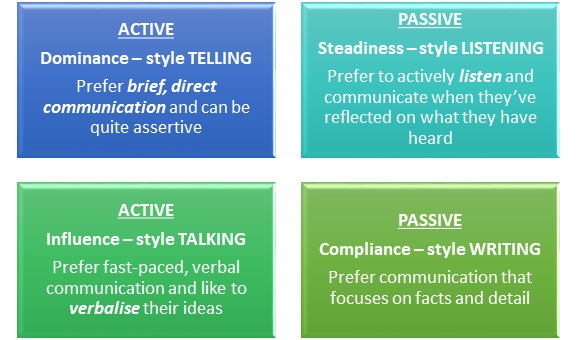
One of the tools that is particularly useful in identifying the behavioural characteristics of individuals is the Thomas Personal Profile Analysis (PPA). This can provide an insight into your and your team’s communication preferences.
The PPA measures preferences around four core behavioural and communication styles1:
TOP TIPS:
Know your behavioural style and preferences
Know your team’s behavioural styles and preferences
Modify your style to match theirs when you communicate with them
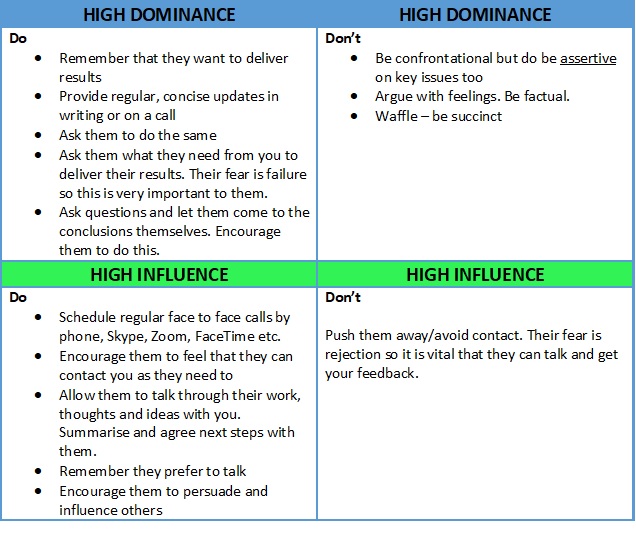
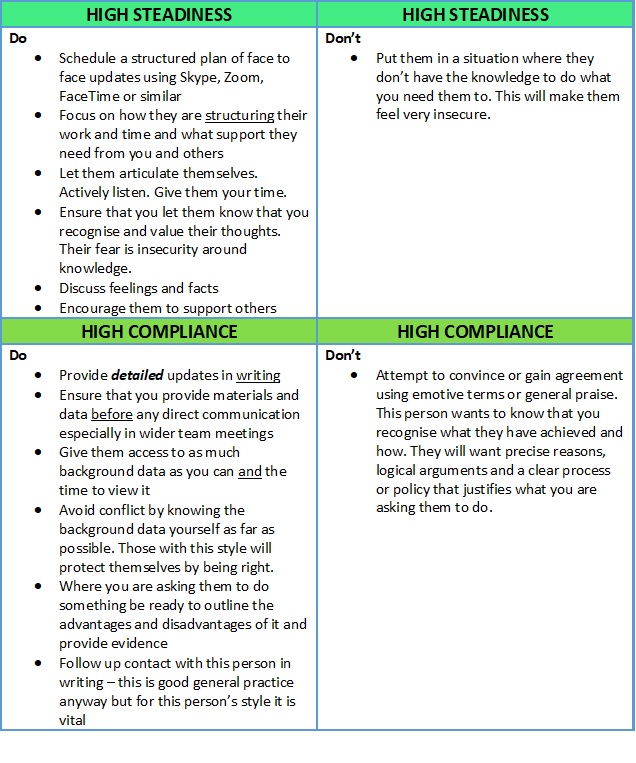
Dos and Don’ts for communication with individuals with each style
These are dos and don’ts for communicating with your team. Bear in mind your own preferences will have an influence on your natural approach.
ACTIVE
PASSIVE
Next steps
If you would like to find out more about how the PPA could help you and/or your team please get in touch.
Steve Bax is an accredited practitioner for PPA (Personal Profile Analysis), HPTI (High Potential Trait Indicator), and TEIQue (Trait Emotional Intelligence Questionnaire) assessments (Thomas International).
With thanks to Thomas International for some of the content detail. For more information on using the PPA to help make remote working communication successful, see the excellent blog by Jayson Darby at Thomas International here
Along with many other companies in this field, we are working from home during this difficult time. If we can provide any help or advice on research, business strategy, team working, managing change, effective communication approaches for remote working and people development please don’t hesitate to contact us.
Face to face research
Bax Interaction is following the advice given by the government and the MRS (Market Research Society) from a research perspective and will not undertake any face to face research at this time. We will continue to offer non-physical contact research methods such as: phone interviews; online interviews using technology including Skype, FaceTime and Zoom and online surveys.
Training
Bax Interaction will not be conducting any face to face training at this time. This is due to the strong advice by the UK Government that everyone should avoid non-essential contact and unnecessary travelling. To us this is clear and we would not want to put anyone at risk in a training and development situation. We will continue to offer leadership and personal development training including psychometric assessments via phone and digital means.
Invest time in discovering which of your personality traits can help you to succeed and those that could hinder you.
We offer a completely confidential assessment.
How it works:
1. We send you an invitation to complete a short questionnaire (typically 8 to 10 minutes)
2. We arrange a one to one initial feedback session with you via video conferencing (Skype/Zoom/FaceTime) or face to face (if preferred)
3. Following the session you will receive a detailed report that suggests how you can develop your leadership style Invest in the effectiveness of you and your team now.
Understanding your own capacity to lead as well as this in that of others can significantly add value to your organisation and its stakeholders.
What is a leader?
“A person who influences others because they willingly do what he or she requests”
(Armandi et al 2003)
I like the simple idea that if you are not followed then you cannot be a leader.
Having trained, taught and coached people both in leadership roles or those aspiring to be leaders for many years, I have a strong interest in what it is that makes a person an effective leader.
There are numerous ways in which individuals can find out about their capacity to lead others. For some, this is being given responsibility for people and finding out the hard way. Increasingly though, organisations are far more aware of the risks of doing this and they will provide development programmes, coaching and training to grow their own leaders and if recruiting from outside will look at an individual’s track record as an indicator of likely success.
What is potential?
“A person with potential is one who can grow to maximise or optimise their talent”
In the context of leadership we are looking at the factors that, when combined, give an individual a high probability of success.
If we know what these factors are, we can begin to make key decisions about our own and others’ future roles and development.
Research has shown that personality traits predict approximately 20% of potential at work. Personality can be described as ‘the way we think’. Our personalities are largely shaped by our early twenties and become less variable as we get older.
There is no simple or single measure of potential. As with all things, some are better suited to certain situations than others.
Key questions around leadership
Anyone with more than a passing interest in leaders will have the heard the question:
“Are leaders born or made?”
Answers on a postcard please!
There is no doubt that training or development can increase leadership potential which is good news. However, clearly there are some people that will be more naturally inclined to thrive in senior leadership positions than others.
What else can help?
I have long been a fan of psychometric assessments in a leadership context as an aid to self-awareness and to give insight for personal development. For you or your existing leadership team they can help with developing positive relationships through being more aware of each others strengths and weaknesses and being able to play to them.
Critically, psychometric assessments can also provide real insight to aid decision making around people development, building leadership teams, succession planning, recruitment and internal promotion.
High Potential Trait Indicator (HPTI)
I use the HPTI from Thomas International as one of the key assessment tools for leadership development.
The HPTI assessment looks at six personality traits. It assumes that certain personality trait levels can indicate a high potential to succeed and be considered ‘optimal’ based on the requirements of a senior executive leadership. Too much or too little of a trait can indicate characteristics that could ‘de-rail’ an otherwise successful person.
The six personality traits measured by the HPTI are as follows:
Conscientiousness – combines self-discipline, an organised approach to work and ability to control impulses which others might give in to
Adjustment – indicates how individuals react emotionally to stress, external events, pressures and relationships
Curiosity (novelty) – how individuals approach novelty, innovation, change, new information and methods
Risk Approach – how someone deals with challenging, difficult or threatening situations
Ambiguity Acceptance (complexity) – an individual’s reaction to complexity and contradictory information
Competitiveness – the relative desire to win, need for power and reaction to winning and losing
Why is HPTI so useful?
It provides a subjective assessment on an individual’s leadership capacity based on their personality traits. This adds valuable insight to career development decision making.
It highlights strengths and weaknesses in the context of where the person is currently in their career and in terms of where they see their future direction.
It can provide an excellent basis for discussion around issues from an organisational leadership perspective.
It aids understanding of how and why some internal conflicts arise and what could be done by modifying behaviour to reduce the impact of these
Do the HPTI assessment yourself or use it to aid recruitment and selection in your organisation
It is unique. There is nothing else like it.
As an existing leader, you can discover what your potential trait indicators are and where they help you to succeed and those that may hinder your effectiveness. Use it to aid decision making for recruitment and selection of successors or to identify potential leaders in the organisation.
If you are keen to take on a leadership role, it may be something that you could ask your organisation to arrange as part of a training or development programme. If this is not possible, consider doing an assessment on your own behalf. It would invaluable for your personal and career development.
When you do the assessment, avoid the temptation to try to answer in a way that you think you should rather than your instinctive response.
Get feedback
Get feedback from an experienced practitioner. This will give you far more insight than a report on its own can. It also avoids you having to try to interpret the findings on your own.
Take the opportunity to discuss the issues that you or the organisation are facing as part of your feedback session
The opportunity to explore organisational culture, leadership and strategic issues as part of this feedback is worth taking. You are able to talk openly in a confidential setting. Sharing issues may generate potential solutions to issues that you have already identified.
Remember there are no good or bad scores!
When looking at your results, think about how your personality traits do and don’t work for you in your current situation and where you might want to modify your behaviour in certain situations to be more effective or to realise your leadership potential in the future.
In a recruitment or selection situation, consider how a candidate’s traits could interact with others in your organisation. Where could there be synergies and how could they improve existing team performance, for example?
Act!
As an existing leader, decide which elements of your HPTI results are priorities for you to focus on. Your feedback and the report will provide suggestions on how to develop your leadership style. Don’t try to do it all at once. Act on the key ones first.
In a recruitment and selection situation, the suggestions in the report can be used in discussion with the prospective candidate.
We can provide the HPTI assessment questionnaire and deliver feedback for you. To find out more contact us today.
Note: We offer Thomas International assessments including PPA, TEIQue and HPTI. For more information click here
With thanks to Thomas International for some of the trait descriptors
Emotional intelligence (EI) is very topical at the moment. It is often discussed as part of effective leadership but is equally important for interactions with all people at work. Understanding emotions can be very advantageous in helping you to realise your potential.
What is emotional intelligence?
A practical definition is:
“Emotional Intelligence is a collection of traits that can help people gauge social and emotional situations and interactions with others”
The elements of EI include:
Self-awareness
The ability to perceive your own and others’ emotions
Self-motivation
Being able to control your impulses
Empathy
Ability to manage stress effectively
Optimism
Modifying your behaviour to suit a situation
There are different ways of measuring EI and these fall into two broad categories – trait and ability.
Trait – measures place people on a continuum for each of a series of self-perceived traits. This allows for shades of ‘grey’. There are no right or wrong answers.
Ability – this considers EI as a cognitive ability that can be measured using performance tests with right or wrong answers.
Why does EI matter?
Self-awareness is a good start point for any development. From my experience of giving feedback sessions on EI assessments over the last couple of years, one of the most powerful ‘light-bulb’ moments for many is discovering that our emotional traits can be visible to others and the potential impacts that this can have. Once you are aware of your own traits you are also more likely to see them in others.
Understanding this and how it affects behaviour can help you to achieve your goals. It is important in work areas as varied as leadership and management, team and project work, selling and customer relationship management but it also matters in our personal lives. It helps us to understand how we appear to our family and friends too and why they behave as they do.
How do I find out what my EI is?
There are various tools available for discovering this. We favour looking at emotional traits assessments rather than ability. We believe this enables a more contextual based set of feedback. In other words, how your ‘scores’ relate both to your current situation and to where you want to be in the future.
If you get the opportunity to find out about your EI – take it!
An assessment may be available to you within your organisation or as part of a training or development programme. If not, think seriously about doing an assessment on your own behalf. It is invaluable for your personal and career development.
When you do the assessment, be truthful in your responses. The first response that occurs to you is usually the right one so don’t overthink it! The TEIQue assessment can identify if there is an indication of ‘impression management’ so avoid the temptation to try to answer in a way that you think you should rather than what you actually feel. It is not a test!
Be open to the results
We would always strongly advocate getting feedback from an experienced practitioner. This will give you far more insight than a report on its own can. It also avoids you having to try to interpret the findings on your own.
There are no right or wrong answers!
We say this a lot during feedback. If you have followed the suggestions in Tip 1, the results will reflect your EI – they will be about you. Think about how your EI does and does not work for you in your current situation and where you might want to modify your behaviour in certain situations to be more effective or to realise your potential in the future.
Avoid looking at scores definitively. A score of 99/100 is not necessarily good and 20/100 isn’t bad! What works in your situation may not be right for others in theirs.
Act!
Decide which elements of your EI results are priorities for you to focus on. Your feedback report should provide suggestions of helpful tips to consider. Don’t try to do it all at once. Act on the key ones first.
Find a ‘sounding board’
Find someone in your organisation, that you can trust, who can give you feedback on how you act and appear in certain situations. Use this to assess where you can improve your interactions with others and how you are doing against the areas that you have identified to focus on.
Steve Bax is an accredited TEIQue Practitioner. Click here to read more and hear his interview with Cambridge Marketing College. For more help and advice on psychometric assessments including TEIQue please contact us today.
In today’s world of big data, AI, machine learning, sentiment analysis, analytics, metrics and more why do we need to bother to use questionnaires?
The simple answer is that we still need primary research or information that is gathered for a specific purpose. Very often, the answers that we are looking for either don’t exist or are not readily available to us.
If we think about Customer Experience (CX), for example, we can glean a lot of insight from user data but we can add even more intelligence by asking specific questions.
So, the questionnaire remains an important tool for most of us. How do we make sure that we design them to be as effective as they can be?
Our top five tips are:
Be clear on why you are creating a questionnaire in the first place
What is it you need to know?
What are the key answers that you want to have at the end of the survey?
Make sure that the collection method or methods are relevant to your target audience
How and when will the questionnaire be delivered? A long paper based questionnaire is unlikely to gain many responses from an audience solely dealing with you online, for example.
Who needs to get the questionnaire? If you have a large customer base, does everyone need to participate to get a representative sample?
Keep the number of questions to a minimum
However much your audience may think of you, there is a limit to the amount of time respondents will give you – no matter much you incentivise them. Time is a precious commodity so respect theirs.
Tell the respondents how long it will take before they start. Be honest.
Make the questions relevant and interesting. The respondents should not be bored with your questionnaire at any stage!
Make the questions clear, easy to understand and answer. Avoid confusing respondents.
Check and double check that all the questions are really Avoid the temptation to ask too much in one questionnaire. We call this the ‘kitchen sink approach’.
Put any classification questions such as where they live, their age, gender, business sector and so on at the end. Your aim is not to create a “why do they need to know this?” brake on their willingness to participate before they have even started.
Don’t forget to include the final ‘gold dust’
“What other comments would you like to make?
This open question gives respondents an opportunity to give you deep insight into the one or two things that they want to tell you but you have not asked them. This can give you invaluable information.
Use a variety of response formats
Avoid the questionnaire being too predictable (that ‘boring’ word again)
Make it fun/ interesting to complete if you can
Consider using video or audio comments, being able to select and deselect in a visual context, graphics, sliders, rating scales, drag and drop, hotspot mapping, timed responses and more. Be creative.
Pre-test. A ‘must’, this one. Prepopulate with responses that you either want to test or have had from pre-testing. A small number of qualitative interviews with selected respondents before designing your questionnaire is an excellent way of finding out these parameters. This keeps completion as easy as possible, will increase response rates and therefore the value of the insight you gain.
Make the questionnaire attractive and easy to complete
Use colour
Use your branding and make it visually appealing. If you don’t appear to care why should they?
Give clear instructions. Assume nothing. Tell the respondents what you want them to do and why, where they go next etc.…
Use progress bars or percentage completed indicators. Reassure them that you have thought about how much of their time this will take.
Use numbered questions and section headings for the same reasons.
Use ‘routing’ and ‘piping’ within the questionnaire to personalise the respondents experience.
Once you’ve designed your questionnaire, test it thoroughly to ensure that it works correctly before you send it out.
Finally, make sure that you meet your obligations from a privacy and data protection compliance perspective.
Good luck with your questionnaire.
For more help and advice on research related matters contact us
We use cookies on our website to give you the most relevant experience by remembering your preferences and repeat visits. By clicking “Accept All”, you consent to the use of ALL the cookies. However, you may visit "Cookie Settings" to provide a controlled consent.
This website uses cookies to improve your experience while you navigate through the website. Out of these, the cookies that are categorized as necessary are stored on your browser as they are essential for the working of basic functionalities of the website. We also use third-party cookies that help us analyze and understand how you use this website. These cookies will be stored in your browser only with your consent. You also have the option to opt-out of these cookies. But opting out of some of these cookies may affect your browsing experience.
Necessary cookies are absolutely essential for the website to function properly. These cookies ensure basic functionalities and security features of the website, anonymously.
Cookie
Duration
Description
cookielawinfo-checkbox-advertisement
1 year
The cookie is set by GDPR cookie consent to record the user consent for the cookies in the category "Advertisement".
cookielawinfo-checkbox-analytics
11 months
This cookie is set by GDPR Cookie Consent plugin. The cookie is used to store the user consent for the cookies in the category "Analytics".
cookielawinfo-checkbox-functional
11 months
The cookie is set by GDPR cookie consent to record the user consent for the cookies in the category "Functional".
cookielawinfo-checkbox-necessary
11 months
This cookie is set by GDPR Cookie Consent plugin. The cookies is used to store the user consent for the cookies in the category "Necessary".
cookielawinfo-checkbox-others
11 months
This cookie is set by GDPR Cookie Consent plugin. The cookie is used to store the user consent for the cookies in the category "Other.
cookielawinfo-checkbox-performance
11 months
This cookie is set by GDPR Cookie Consent plugin. The cookie is used to store the user consent for the cookies in the category "Performance".
PHPSESSID
1 day
This cookie is native to PHP applications. The cookie is used to store and identify a users' unique session ID for the purpose of managing user session on the website. The cookie is a session cookies and is deleted when all the browser windows are closed.
viewed_cookie_policy
11 months
The cookie is set by the GDPR Cookie Consent plugin and is used to store whether or not user has consented to the use of cookies. It does not store any personal data.
Functional cookies help to perform certain functionalities like sharing the content of the website on social media platforms, collect feedbacks, and other third-party features.
Cookie
Duration
Description
lang
session
This cookie is used to store the language preferences of a user to serve up content in that stored language the next time user visit the website.
Performance cookies are used to understand and analyze the key performance indexes of the website which helps in delivering a better user experience for the visitors.
Cookie
Duration
Description
_gat
1 minute
This cookies is installed by Google Universal Analytics to throttle the request rate to limit the colllection of data on high traffic sites.
Analytical cookies are used to understand how visitors interact with the website. These cookies help provide information on metrics the number of visitors, bounce rate, traffic source, etc.
Cookie
Duration
Description
_ga
2 years
This cookie is installed by Google Analytics. The cookie is used to calculate visitor, session, campaign data and keep track of site usage for the site's analytics report. The cookies store information anonymously and assign a randomly generated number to identify unique visitors.
_gid
1 day
This cookie is installed by Google Analytics. The cookie is used to store information of how visitors use a website and helps in creating an analytics report of how the website is doing. The data collected including the number visitors, the source where they have come from, and the pages visted in an anonymous form.
is_unique
5 years
This cookie is set by StatCounter Anaytics. The cookie is used to determine whether a user is a first-time or a returning visitor and to estimate the accumulated unique visits per site.
sc_is_visitor_unique
2 years
This cookie is used to store a random ID to avoid counting a visitor more than once.
Advertisement cookies are used to provide visitors with relevant ads and marketing campaigns. These cookies track visitors across websites and collect information to provide customized ads.